This might not be a huge surprise, but every graphic novel is unique. Different authors mean different storylines, narratives, and writing styles. Different artists mean varying styles and strokes. This seems really obvious, but I never thought of just how much it matters when reading a comic book. When I first started reading comic books, it took me forever to read because I had to adapt the way I read to include both text and graphics. But I’m realizing more and more that even if I read comic books exclusively, it would take me time to adapt from one comic book to the next just because of the varying styles of art and presentation of text. In many ways, I think that’s why I find it easier to read novels. I still have to get in the groove of any particular author, but the text-base is familiar and there’s less of a “learning curve”.
I’m not too savy in analyzing art, but I know what I like when I see it. What’s really intriguing to me about comics is what you can say without ever saying anything. Reading Scott McCloud’s “Understanding Comics” has really opened my eyes in what one transition from one panel to the next might say and how it all comes together. The text, too, plays a part in this. The way it’s physically set up on the page can make a world of difference. Reading Pratt’s article (2009) on narration reinforces this idea to me. However, I think it’s much more complex than Pratt gives it credit for. The variation of bubbles and narration within comics can’t be explained in neat little categories. Because each author and artist’s work is unique, I think it’s impossible to constrain them to certain categories.
Take this sequence from Alison Bechdel’s Fun Home.
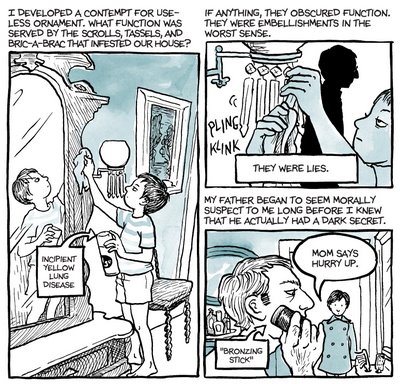
The narration can be a block paragragh at the top or bottom of the panel, or enclosed in a box. Then, there are these asides with the “bronzing stick” and “incipient yellow lung disease” that are not quite what Pratt describes as diegetic because they are not in the character’s world, but rather meant for the reader.
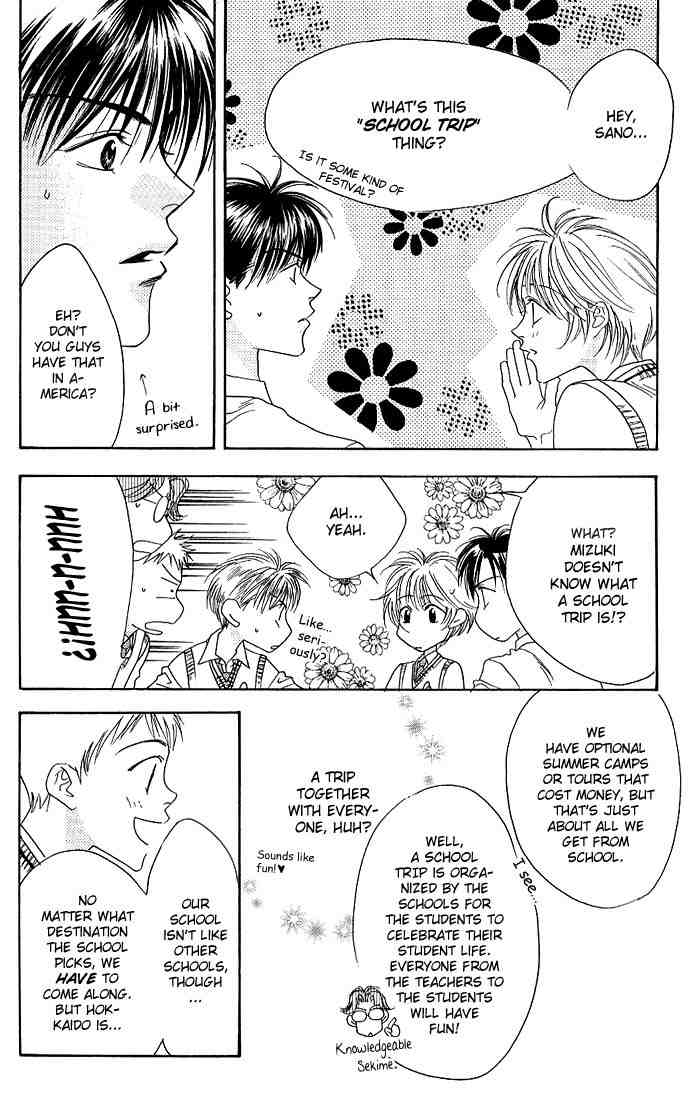
Now, if I look at the manga Hana Kimi by Hisaya Nakajo, there’s a completely different style. In the following page, the author/artist states exactly how a character is feeling “a bit surprised” and conveys that a certain character is talking in the very bottom right hand speech bubble by putting a simplistic, tiny head in the bubble. These small style choices don’t fall into Pratt’s examples of narration categories.
From the limited graphic novels and manga that I’ve read, I believe, as a whole, manga is much more plain-spoken. It tends to spell things out instead of leaving the images, narration, or panels to speak for themselves. However, this panel from Neon Genesis Evangelion by Yoshiyuki Sadamoto seems to tell very little and leaves most of the character’s feelings up to the reader. A lot of this is soley author/artist style and preference in narration and storytelling.
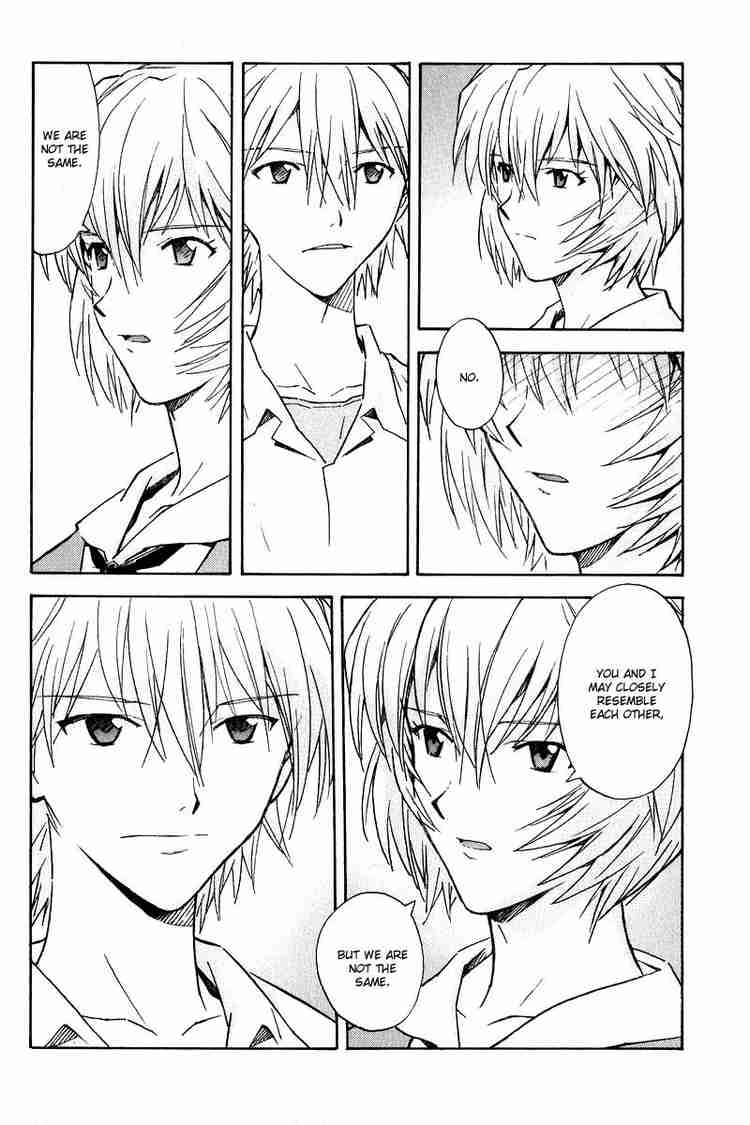
It’s examples such as this that make me believe that the act of reading a graphic novel is a very personal action. Not only are comics complex because of the way an author and artist decide to portray their story, but it also has to do with each individual reader’s personal experience. My take on a scene in a graphic novel could vary drastically from another person’s, not only because of possible misconceptions (maybe a drawing of a mad person looks more like a sad person in my eyes), but also because of my past experiences with a given situation. My reading of these character’s emotions and relationship based on my past experiences and background could be different from someone else’s.
What I’ve taken from comics so far is that they’re much more complex than I first thought. The thought that goes into spatial recognition, passage of time, how we interpret the images or sounds from the text, how it all comes together to create such a strong feeling and knowing of the panel and from the panel to the page to the chapter to book. It’s all amazing. The distinct work of each individual author and artist and their own form of narration all impacts the end product and how the reader experiences all of it. This isn’t to say that literary novels don’t have some of these components, they do. It’s just the way comics achieve this is different from the way novels achieve it.
Articles and Books mentioned in this post:
Books:
-Bechdel, Alison. Fun Home: A Family Tragicomic. Boston: Houghton Mifflin, 2006.
-McCloud, Scott. Understanding Comics: The Invisible Art. New York: HarperPerennial, 1994.
Series:
Hana Kimi by Hisaya Nakajo
Neon Genesis Evangelion by Yoshiyuki Sadamoto
Articles:
– Pratt, H.J. (2009). Narrative in comics. The Journal of Aesthetics and Art Criticism 67(1), 107–117.
 Librarian Ginny
Interesting post. I think there’s a very unique aspect of graphic novels in that the manuscript isn’t the complete work. Just like a motion picture script isn’t the movie. In my experience it also takes a unique editor to make that leap. They have to be willing to realize that the words on the pare are only a portion of the complete work. The the final work is a combination of words and art and in my experience they can alter one another as the project develops. And obviously some graphic novels are very talky and some aren’t. I’ve enjoyed GN’s in both cases.
Thank you. You make a good point on how an editor can also interact in the dynamic of the team for any given work. I think graphic novels are so interesting in that aspect. Potentially, there can be many people working on different parts of one graphic novel and each of them can influence the others to create a very intriguing collaboration that can build upon itself as it’s created.
I have to admit, I haven’t read many graphic novels that aren’t very talky. I’d be interested to read a few and see which I, personally, prefer (or if there is a preference at all).