It’s back to the great shelving debate for my comics class after reading Weiner’s section on cataloging. Among the readings, Tarulli’s essay gives a good overview of the difficulties in cataloging and shelving graphic novels and comics. Comics take on all sorts of genres such as biographies, fantasy, horror, mystery/detective, romance, etc. Many people tend find a genre or two that they like (or an author) and stick with them. They tend to browse in that genre or branch out to other authors who are “read alikes.” It would make sense to people who follow this pattern for their library to interfile their graphic novels and comics so that they fit genre.
However, I personally know a lot of people who specifically seek out the graphic novel and comic format or medium and rarely go outside of it. For people such as this, shelving graphic novels all together makes sense. We’ve talked a lot in this class and I’ve read a fair amount of articles with suggestions and case studies, but, to be perfectly honest, I don’t like any of the options I’ve come across because I don’t think there’s a universal solution. For the most part, I believe any given library needs to take a look at their own community, maybe take surveys, within their population and figure out which option is a fit for them.
Ok, now for the graphic novel book review portion of this post! We looked at graphic biographies this week. Specifically, Anne Frank: The Anne Frank House Authorized Graphic Biography by Sid Jacobson and Ernie Colon and The 14th Dalai Lama by Tetsu Saiwai. I enjoyed both mostly because I don’t know much about either Anne Frank or the Dalai Lama other than the brief introduction to them in school when I was younger.

So I found the actual material interesting. However, I felt like I connected more to The 14th Dalai Lama (above). I felt like it took the genre of biographies and really made it accessible. The artwork was really good even though it’s not my personal favorite and the text wasn’t overwhelming. I felt like there was a good balance between text and image and that it merged together well. I really loved that it didn’t read like a textbook, but rather played out like a story. A lot of biographies I’ve read tend to do this and become stuffy and a little dull.
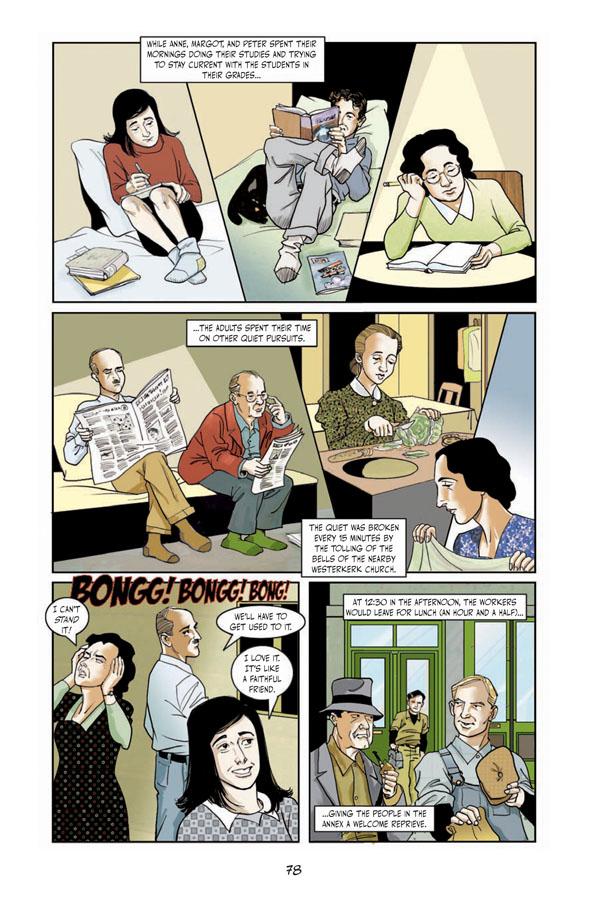
Now, I felt a little differently about Anne Frank: The Anne Frank House Authorized Graphic Biography (above). It was pretty text heavy and was told in such a omnipresent way that I couldn’t really identify with Anne at all. In addition to this, I really didn’t connect with the artwork at all. In my opinion, it wasn’t particularly interesting, eye-catching, or fresh. Something that just bothers me in particular, and I don’t know if anyone else ever feels this way, is when the artwork is realistic yet the proportions are a little off. This tends to bother me a lot. So, the combination of not being taken with the text and art just made this a really slow-paced read for me. I didn’t hate the book at all, but I probably wouldn’t pick it up again.
Works Mentioned In This Post:
Jacobson, Sidney, and Ernie Colón. Anne Frank: The Anne Frank House Authorized Graphic Biography. New York: Hill and Wang, 2010. Print.
Saiwai, Tetsu. The 14th Dalai Lama. Los Angeles, CA: Emotional Content, 2008. Print.
Weiner, Robert G. “Part 9: Cataloging.” Graphic Novels and Comics in Libraries and Archives: Essays on Readers, Research, History and Cataloging. Jefferson, NC: McFarland &, 2010.
 Librarian Ginny
I agree about the Dalai Lama biography being much better than the Anne Frank. It seems like a lot of people are complaining about that, especially the text-heaviness and the art. I think one of the things that consistently bothered me about it was the way the artist drew Anne’s face: she always ended up looking much, much older than it should have, almost like an old woman, and not like the actual pictures that I’ve seen of Anne Frank.
As far as cataloging graphic novels go, I think it is best to put them all together. When I go into a bookstore or a library, it is much more convenient to only look in one place for them, than to try to find the genre and then the author.