Children’s librarians talk a lot about early literacy. It can become one of those buzz words that organizations look for, but it is so much more. There’s really so much riding on it for young children, so let’s talk a little about why.
According to the Center on the Developing Child, over a million new neural connections are formed every second in a baby’s brain. A million! These connections enable lightning-fast communication among neurons that specialize in different kinds of brain functions. The early years are the most active period for establishing neural connections (or synapses), but new connections can form throughout life and unused connections continue to be pruned.

For example, the illustration on the left shows a stark difference between the 2 year old, when synapse creation is at its peak, and 4 years old, when pruning begins in earnest. More importantly, the connections that form early in life provide either a strong or weak foundation for the connections that form later in life. This is especially important if a child is neglected or abused early in life when these connections are more important.
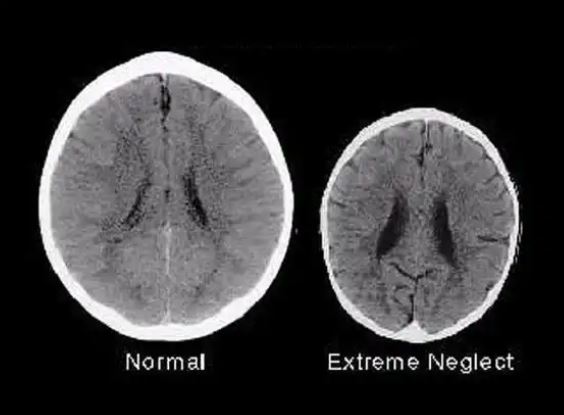
However, if a brain is constantly reacting to the stress and trauma around it, then it has less time and resources to focus on creating new neural connections and developing things like language. The ongoing nature of chronic neglect or abuse significantly impacts the brain in infancy and early childhood. Neglect at this phase impedes formation of those neurological synapses that are essential to communication in the brain. In particular, neglect has been shown to harm the frontal cortex, the area of the brain responsible for planning, decision making, and memory. Extreme neglect can actually make children’s brains smaller.
This goes back to Erik Erikson’s theory of psychosocial development. His conflict in the infancy stage is Trust vs. Mistrust. Obviously, if we as infants are not getting our needs met, we will become unsure of our environment and our caregivers. For healthy development and movement into the next stage, we require our physical and emotional needs to be consistently met.
But, if children grow up in an interactive and engaged home with parents and caregivers that meet their needs to lower the word gap, then they start off ahead of the game. Children who start kindergarten ready to learn and to read have greater success throughout their school years. They are more likely to read at or above grade level by the end of 2nd grade. And if continued, by 4th grade they’d be more likely to graduate from high school. It has long reaching effects in that child’s life.
And this is why children’s librarians dedicate a lot of thought and time to this subject. This is why Early Literacy is much more than a buzz word.
 Librarian Ginny